Lyophilizing critical reagents within diagnostic microfluidic cartridges can improve assay accessibility, increase shelf life and obviate the need for cold chain logistics. Moreover, when done so combining modern single-dose technologies and pick and place automated assembly, the process can also significantly reduce the cost-per-test of near-patient diagnostics.
In this blog we examine the process in detail, and outline the advantages and challenges associated with it.
What is Microfluidics?
Microfluidics is the precise manipulation of liquids on a sub-millilitre scale. By providing controlled flow and mixing of samples with integrated assay reagents, microfluidic technology has enabled rapid diagnostic testing to take place away from the laboratory, making it available within remote communities and to those unable to travel. This also significantly increases speed to result, as there is no need to transport samples to a laboratory for analysis.
Integration of assay reagents
Assay reagents in microfluidic cartridges can be integrated as either liquid or dried components. Liquids, such as buffers, are typically stored in blister packs with frangible or pierceable seals that can be physically actuated. However, drying critical reagents such as enzymes, antibodies, proteins, and DNA, reduces their degradation rate by removing water, thus increasing the product’s shelf life.
Drying processes
Conventional oven-curing and air-drying: require elevated temperatures but offer reduced drying times and scalable, cost-effective equipment.
Low temperature vacuum-drying: uses sub-ambient temperatures and low pressure to evaporate water from reagent formulations.
Lyophilization (freeze-drying): involves freezing the reagent and sublimating the ice as water vapor under very low pressures.
Conventional oven drying and air-drying usually require elevated temperatures compared to low temperature vacuum and freeze drying. Therefore, it may not be appropriate for temperature-sensitive reagents, such as enzymes, as they may be thermally inactivated during air-drying or oven-curing, making low temperature vacuum-drying and lyophilizing the only viable options.
Integration techniques
If thermal inactivity is a risk and the decision is made to dry, reagents are typically integrated into the cartridge as liquids and then dried. Various techniques, based on factors such as volume, volume accuracy, positioning accuracy, and throughput, are utilised for liquid reagent deposition. These techniques include:
- Contact Processes: Pipetting and spotting robots, contact printing.
- Non-Contact Processes: Piezoelectric printing, spraying.
Recently however, lyophilized reagents in the form of spherical beads or hemispherical pellets have significantly improved throughput rates. These beads are batch-manufactured in hundreds of thousands and precisely positioned into fluidic cartridges using ‘pick and place’ automation. This method saves valuable freeze-dryer space by negating the need for in-situ lyophilization.
Challenges in reagent reconstitution
Reconstituting and releasing reagents consistently is a significant challenge in microfluidic cartridges. Effective dissolution depends on formulation, surface area, surface properties, and mixing (passive and active). Inconsistencies in dissolution can lead to assay variability and inaccurate results.
Passive dissolution
Passive dissolution involves the interaction of a dried reagent with its surrounding solvent without external mixing forces. This process occurs in two stages:
- The dried reagent is wetted and detached at the interface of the reagent and bulk solvent.
- The detached reagent diffuses into the bulk solvent, governed by Fick’s laws of diffusion, which describe the movement of molecules from higher to lower concentration.
The rate-limiting factors include the surface area and geometric shape of the dried reagents. Lyophilized beads, with their greater surface area and porous structure, provide improved dissolution and diffusion rates.

Figure 1: Examples of Lyophilized beads. Images courtesy of Biofortuna
Optimising reconstitution
Developing dried reagents for optimal reconstitution requires understanding their interactions with the solvent in the fluidic cartridge. This can be challenging due to the low volumes and translucency of wetted reagents. Adding coloured or fluorescent tracer dyes to the dried reagents or solvent can help visualize and understand the dissolution process. Properly employed, these dyes can determine the optimal deposition process and formulation.
The reconstitution and release of reagents in a timely and consistent manor is a major challenge when integrating dried reagents into a microfluidic cartridge. Formulation, surface area, surface properties and passive and active mixing should all be taken into consideration for achieving effective dissolution. Inconsistencies in reagent dissolution can lead to undesirable assay variability and inaccurate results.
Lyophilized beads
Lyophilized beads are made by dispensing an accurate volume of reagent into liquid nitrogen which freezes the reagent as spheres. The frozen spheres are transferred onto trays and then subjected to lyophilization. The physical strength, stability and reconstitution rate of the lyophilized bead are primarily controlled by the formulation using a variety of sugars, polymers, surfactants and other substances often in combination.
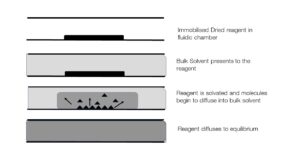
Figure 2: Schematic of passive diffusion of dried reagents
The diffusion of reagent molecules from the solvated layer to the bulk solvent is usually the rate limiting factor as well as surface area of the reagent. Geometric shape and porosity of the dried reagents also influence the dissolution and diffusion rates. Lyophilized beads provide greater surface area and are porous in structure due to the voids left by sublimated Ice crystals.
Developing dried reagents for optimal reconstitution in fluidic cartridges that are reliant on passive diffusion requires understanding of the interactions of the dried reagent and solvent in the fluidic cartridge itself. This can be quite challenging because the solvated reagent is difficult to visualise due to the low volumes and translucency of wetted reagents. Addition of coloured or fluorescent tracer dyes to the dried reagents or solvent can be used to visualise and better understand the dissolution process. It is important that the dye and its concentration does not influence the reconstitution properties, when properly employed they can be used effectively to determine the optimal deposition process and formulation.

Figure 3: Examples of lyophilised bead reconstitution experiments at Biofortuna in fluidic chambers using fluorescent tracer dyes.
Conclusion
Lyophilizing reagents into diagnostic microfluidic cartridges holds immense promise for advancing point-of-care diagnostics.
Despite the expertise required to lyophilize reagents within microfluidic devices, the potential to deliver quick, accurate and affordable near patient diagnostic testing makes it a crucial innovation in the fight against infectious disease.
Download our latest Lyophilisation whitepaper
Learn how to find your formulation’s collapse temperature
Understand about the role of critical temperature modifiers
Identify the challenges of designing a freeze drying protocol

About Biofortuna
Biofortuna is an international IVD contract development and manufacturing business. We provide assay development and manufacturing services, with a wealth of expertise in immunoassay and molecular diagnostic assay stabilization. Our FDA registered and ISO 13485 certified facilities provide small scale pilot batch manufacture up to full commercial production of finished diagnostic kits.
TALK TO A LYOPHILISATION EXPERT
Great ideas start with a conversation. To discuss how we can help you lyophilise reagents within microfluidic devices, fill in the form below

Comments are closed.