During assay development, the feasibility stage is often viewed as a simple proof of concept. Can the assay detect its intended target? Are the initial results promising? And while these questions are fundamental, promising results alone don’t guarantee a successful path to commercialisation. Many assays perform well during initial development but can encounter challenges later because reproducibility and manufacturing requirements weren’t considered from the start.
At Biofortuna, feasibility isn’t treated as an isolated proof of concept. Every project begins by understanding what the product is intended to achieve, where it will be marketed and the regulations it needs to follow. These early decisions shape the entire development strategy, helping to build assays that are designed not just to work, but to succeed in real world environments.
Defining the destination before assay development
We support customers at different stages of development – some have an initial concept, while others have an established assay they want to optimise or commercialise. Regardless of the starting point, our first step is understanding the indented use of the product and the markets it is designed to serve.
Whether the end goal is FDA clearance, IVDR compliance or another regulatory pathway, these decisions influence every stage of assay development. Establishing these requirements early allows us to develop a strategy that aligns scientific development with regulatory and commercial objectives, reducing the risk of costly redesign or delays later in the project.
Feasibility is more than proving the concept
The purpose of a feasibility study is to determine whether an assay concept is technically viable. During this stage, developers assess whether the proposed design can reliably deliver the intended results and identify opportunities for optimisation. Typical questions include:
- Can the assay detect what it’s designed to?
- Does it perform as expected?
- Is the assay design fit for purpose?
However, demonstrating technical feasibility is only the beginning. A successful assay must also be capable of progressing through verification, validation and commercial manufacture without introducing unnecessary technical or operational challenges.
Designing for manufacture
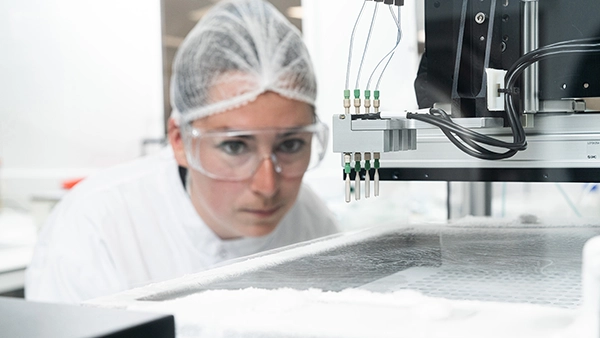
One of the biggest advantages of designing for manufacture during assay development is that potential barriers can be identified while there is still flexibility to address them.
Material selection, workflow integration and supply chain resilience all influence how successfully an assay can move into commercial manufacture. For example:
- Materials that are suitable for small-scale development may present supply chain or cost challenges as production increases.
- Workflows must integrate effectively with the wider diagnostic process to help minimise disruption later in the project and support a smoother transition into manufacturing.
- Assay stability must also be considered early. Understanding how long reagents remain stable during dispensing and selecting the appropriate assay format and manufacturing process helps ensure consistent quality during production.
Future proofing isn’t simply about preventing issues – it’s about giving an assay the best possible chance of long-term success. That’s why we consider production requirements from the earliest stages of development, not after feasibility has been completed.
Demonstrating robustness and reproducibility
After feasibility has established that an assay concept is viable, development focuses on demonstrating that performance can be reproduced consistently.
- Robustness testing evaluates how tolerant an assay is to changes in operating conditions and instruments.
- Reproducibility ensures that the same quality results can be achieved whether manufacturing ten kits or ten thousand.
This requires careful optimisation of assay design, reaction conditions and sample processing, alongside rigorous testing throughout. We evaluate factors such as primer specificity and sensitivity, optimisation of reaction conditions and sample performance to ensure the assay can perform reliably throughout verification, validation and production.
Read our blog on transferring lyophilised assays from development to commerical manufacturing.
Risk assessment starts early
Successful assay development also requires quality to be built into development from the very beginning.
At Biofortuna, risk management begins during feasibility and is closely supported by our ISO 13485 accredited quality management system. While product designs are still flexible, we assess supplier management manufacturing processes, laboratory capabilities and documentation requirements to ensure development progresses within a controlled quality framework.
Comprehensive documentation underpins this process. Throughout development, we maintain clear records of design decisions, optimisation studies, experimental outcomes and risk assessments. This supports traceability, regulatory submissions and technology transfer, helping customers build the evidence required for regulatory review with confidence.
Building assays with the future in mind
Future proofing assay development isn’t simply about designing an assay that works today, it’s about making smart decisions at the very beginning of the project.
We support customers from the earliest product concept through feasibility, optimisation, validation and commercial manufacture. By combining scientific expertise with regulatory knowledge and manufacturing capability, we help reduce development risk, avoid unnecessary redesigns and transform promising assay concepts into robust, commercially ready diagnostic products.
Whether you’re starting with an initial concept or looking to advance an existing assay towards commercial manufacture, our team can support every stage of the journey. Get in touch to discuss your project and discover how our end-to-end assay development expertise can help future proof your next project.
Comments are closed.