What is glycerol?
Glycerol, also known as glycerin, is a colorless, odorless, and sweet-tasting viscous liquid that is hygroscopic and soluble in water. It is a simple polyol compound, consisting of three carbon atoms, each attached to a hydroxyl group (–OH). Glycerol is a byproduct of the soap-making process and the biodiesel production process, and it is widely used in food, pharmaceuticals, and cosmetics due to its moisturizing properties and ability to act as a solvent and preservative.
Additionally, glycerol plays a crucial role in biological systems as a component of triglycerides and phospholipids, essential for energy storage and cellular structure.
Why do reagents contain glycerol?
Many commercially available diagnostic reagents, particularly temperature sensitive proteins such as enzymes and antibodies require freezing for long term storage conditions. These are often supplied in a storage buffer system containing glycerol at concentrations between 10 and 50%w/v. Glycerol is added to the storage buffer as a cryo-preservative to prevent the stresses of freezing and thawing from denaturing the protein.
What impact does glycerol have on lyophilised formulations?
During lyophilisation the glycerol concentration in a formulation increases as water is removed by sublimation during primary drying. This has a plasticising (softening) effect on the lyophilised structure which then becomes glassy during secondary drying. The result is a product that may not be completely dry or will have poor structural appearance. This in turn will impact the products stability and reconstitution properties.
The carryover of residual glycerol from some reagents into the final formulation can vary in concentration significantly. Whilst some lyophilised formulations can tolerate relatively low concentrations of glycerol we typically see impacts on drying and appearance above 0.1%w/v and sometimes significantly lower depending on the formulation.
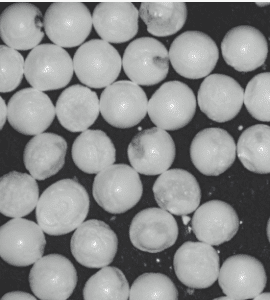

Left – With Gylcerol Right – Without Glycerol
What should I do if I suspect my reagents contain glycerol?
Many of our clients initially approach us with little or no understanding of the lyophilisation process, having already invested a significant amount of resource developing an optimised ‘wet’ assay formulation only to be told that it may not be compatible for lyophilisation due to glycerol and other non-compatible components.
Consider the final intended formulation and its manufacturing process at the earliest point in your design and development process. We can help you co-develop your critical chemistries by simply offering advice or conducting small feasibility trials on your behalf.
Are there commercially available reagents that do not contain glycerol?
Several suppliers of critical reagents for use in diagnostics recognise the impact of glycerol on lyophilisation and provide options that are either glycerol-free or ‘lyo-compatible’. Lyo-compatible reagents contain either levels of reduced glycerol or increased concentration of the stock protein so the glycerol becomes diluted to a negligible amount in the final formulation.
There are some formulated reagents such as PCR master-mixes that may be classed as ‘lyo-ready’ meaning they contain all necessary components for lyophilisation at recommended lyophilisation parameters.
These options can be convenient for use but are not always compatible in certain assay formats and can also have a significant cost implication.
Is it possible to remove the glycerol from a reagent?
The simple answer is yes but there can be some challenges associated with this strategy as other components can be also co-removed which may impact performance.
We use a process referred to as ‘buffer exchange’ which essentially swaps the original buffer containing glycerol that the critical protein/molecule is supplied in for a glycerol free buffer.
There are three methods of buffer exchange based on size exclusion that our trained biochemists employ depending on the application, Dialysis, Diafiltration and Gel Filtration.
Dialysis works by diffusion through a semi-permeable membrane with a known molecular-weight cutoff (MWCO) due to the size of its pores. The protein sample containing the glycerol and an exchange buffer solution are placed on opposite sides of the membrane in the form of a cartridge or tubing. The protein (which should be much larger than the membrane pores) is retained on the sample side of the membrane whilst the smaller glycerol molecules diffuse freely through the membrane and approach an equilibrium concentration with the buffer exchange solution (dialysate). The volume ratio of dialysate to sample should be greater than 200:1 to ensure that the glycerol is reduced to a negligible level.
Diafiltration works in a similar way to dialysis as it also uses a semi-permeable membrane to separate large proteins from low molecular-weight molecules. However, unlike dialysis, which relies on passive diffusion, diafiltration involves forcing the original buffer solution through the membrane by positive pressure or centrifugation force. The target protein becomes concentrated to a smaller volume as the buffer containing the glycerol is forced across the membrane as the eluate. The volume of eluate is replaced by fresh glycerol free buffer. When this is repeated several times the glycerol is reduced to a negligible level.
Gel filtration buffer exchange is performed by first equilibrating the column containing a porous resin of known pore size with a glycerol free buffer. The protein buffer containing the glycerol is then passed through the column. The protein is too large to enter the pores and will quickly passes through the column. In contrast, buffer salts and glycerol will enter the pores of the resin, slowing their rate of migration through the resin bed. This reduction in flow rate causes the larger protein to become separated from the slower, smaller molecules and collected into the new buffer formulation.
We have successfully employed buffer exchange for several commercialised products including litre level volumes of PCR master-mix used for Covid testing.
Download our latest Lyophilisation whitepaper
Learn how to find your formulation’s collapse temperature
Understand about the role of critical temperature modifiers
Identify the challenges of designing a freeze drying protocol

In summary
- Some critical reagents including enzymes and antibodies contain glycerol and other non-compatible components for lyophilisation.
- Residual glycerol may impact the lyophilised products appearance, reconstitution and stability properties.
- Selecting glycerol free reagents or removing glycerol from reagents should be considered.
- Tap into Biofortuna’s development and manufacturing expertise on stabilised reagents for lyophilisation
Why Biofortuna?
As a lyophilization specialist, we have extensive experience and a proven track record in the development and large-scale manufacture of molecular PCR, LAMP and immunoassays and stabilization of immunodiagnostic reagents.
We listen to your requirements, develop customized solutions and deliver them with openness and transparency.
Operating from state-of-the art, purpose built premises and hold ISO 13485 and ISO 17025 accreditation and FDA registration. We work with complex formulations (including NGS reagents, micro spheres, paramagnetic particles, latex and colloids) and bio conjugation reactions with enzymes, antibodies and molecular probes.
Our scientific team has experience in a range of assay technologies including:
- Polymerase chain reaction (PCR)
- Quantitative multiplex polymerase chain reaction (qPCR)
- Reverse transcription polymerase chain reaction (RT-PCR)
- Next generation sequencing (NGS)
- Isothermal nucleic acid amplification technology (iNAAT)
- CRISPR-Cas9 and TALEN-based gene editing
- Microarrays
- Digital droplet polymerase chain reaction (ddPCR)
- Biosensors
- Immunoassay (ELISA)
We partner with some of the world’s most innovative product developers, supporting their assay development from concept through to commercialisation.
TALK TO A LYOPHILISATION EXPERT
Great ideas start with a conversation. To discuss how we can help you lyophilise your assay, fill in the form below

Comments are closed.