Assay scale up: Your five point checklist
Taking an assay from development to commercial scale manufacture is a complex process. Can the formulation be stabilised? Do you have the regulatory approval? And not least, how do you plan for fluctuations in demand?
Unless you plan for assay scale up at the design stage, it’s quite common to find that what works in development does not transfer smoothly into manufacture.
Our five point checklist below outlines the steps you can take early in your development journey to increase the likelihood of a smooth transition.
It’s always better to plan ahead, so if you have any additional questions or want to discuss a specific issue you are facing, please fill in the form on this page or call us on +44 151 334 0182

Plan early for regulatory approval
Even if you intend to initially launch your assay for research use only, it will save a lot of time to think about the regulatory requirements at the outset if there is any intention to market it for diagnostic use in future.
Implementing a design control process will enable you to prove that your product is safe and effective and suitable for its intended use. Medical devices such as diagnostic assays are subject to defined design controls such as the FDA’s CFR 820.30 and ISO 13485. Design controls also decrease the time required for re-work and corrections during the develoment process, so the earlier they are implemented the better.

Define your manufacturing workflow
The format of your assay will have a big impact on the degree of automation possible, the throughput you can achieve and the cost per test.
It’s essential to a have a clear understanding of how you will provide your assay to the end-user. For example, will you supply it as a bulk master mix or individual replicates in plates or as beads?
Consider any specific requirements your assay may place on the manufacturing process and identify where any bottlenecks or points of particular risk may occur. For example, does your formulation have a stability window; are you intending to supply using bespoke plates?
If you are developing a Point of Care assay, it’s important to ensure that the processes developed in the laboratory will replicate within the microfluidic device and that there are no other physical interactions that could affect assay performance such as operating temperature or interference from the cartridge materials.

Consider how your assay will be transported and stored
Another critical factor which will have a major influence on the manufacturing process is how you will maintain assay stability during transportation and storage.
If you are supplying a wet assay, will it require cold chain storage? Is that practical for your market? Is it affordable? Will it allow your customers to reduce their environmental impact?
Alternatively, if you are considering stabilising your assay by air drying, are you sure the process will not damage any critical components?
Similarly, if you are considering lyophilising, make sure you have access to the specialist expertise required. Formulations containing glycerol or other high detergent concentrations are notoriously problematic.
Doing this early will allow you to consider alternatives and identify the excipients and buffers appropriate for your assay.
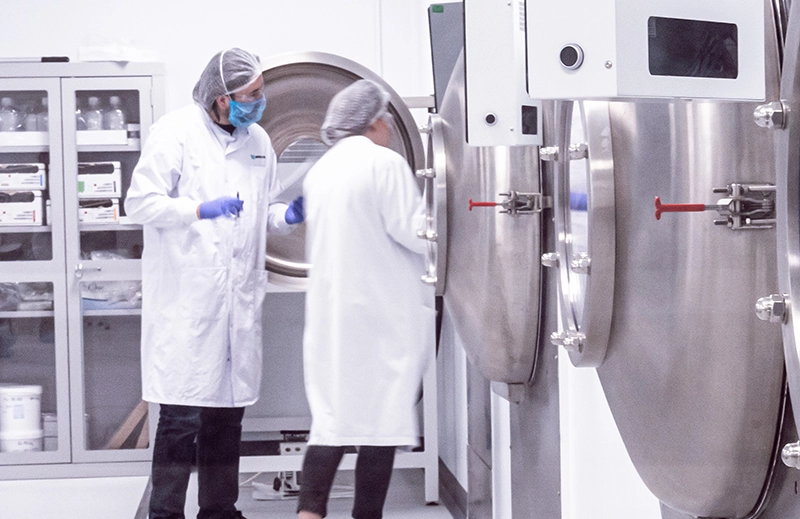
Ensure you have the manufacturing capacity to meet demand
It may sound obvious, but demand rarely follows a predictable, linear pattern.
Build contingencies to deal with fluctuations; it may take longer for demand to mature than you anticipate, or you could experience sudden spikes.
Even if you are planning to manufacture in-house, it’s worth engaging with contract manufacturers that can help you scale up in line with demand, without having to invest in additional equipment or people.

Review your supply chain
Build a robust supply chain and take advantage of your suppliers’ expertise. Ensure they hold the appropriate quality standards and audit them regularly.
Understand their capabilities and utilise them to bring the experience and resources you need into your development and manufacturing processes.
Ideally your supply chain will be lean enough to be efficient but with contingency built in to mitigate the risk of a single point of failure. You may wish to identify second line suppliers and consider the geographical spread of your supply base, depending on where you intend to market your assay.
Ultimately engaging with your suppliers early will greatly enhance the likelihood of a smooth transition into large scale manufacture.

Why Biofortuna?
As contract development and manufacturing specialists, we have extensive experience and a proven track record in the development and large-scale manufacture of molecular PCR, LAMP and immunoassays and stabilisation of immunodiagnostic reagents.
Operating from state of the art, purpose built premises and holding ISO 13485 and ISO 17025 accreditation and FDA registration, we listen to your requirements, develop customised solutions and deliver them with openness and transparency
Our scientific team has experience in a range of assay technologies including:
* Polymerase chain reaction (PCR)
* Quantitative multiplex polymerase chain reaction (qPCR)
* Reverse transcription polymerase chain reaction (RT-PCR)
* Next generation sequencing (NGS)
* Isothermal nucleic acid amplification technology (iNAAT)
* CRISPR-Cas9 and TALEN-based gene editing
* Microarrays
* Digital droplet polymerase chain reaction (ddPCR)
* Biosensors
* Immunoassay (ELISA)
We partner with some of the world’s most innovative product developers, supporting their assay development from concept through to commercialisation.
Get in touch to arrange an informal exploratory discussion
GREAT IDEAS START WITH A CONVERSATION
To discuss how we can help you scale your assay, fill in the form below